Germany residence permit
Six grounds for a residence permit, each with its own rules on work, money and family. We choose the one that fits your degree, income and plans for citizenship.
- Routes
- 6 programmes
- Permanent residence
- from 21 months
- Citizenship
- after 5 years
Germany issues residence permits on specific grounds set out in the Residence Act (AufenthG). Qualified professionals with a degree and a job offer come on the EU Blue Card, and those who want to look for work on the spot come on the Opportunity Card. There are also permits for running your own business or freelancing, for living on your own means, for study and for family reunion. Germany has no residence by investment, and buying property does not give a right to a residence permit.
You first get a national D visa at a German embassy, then the foreigners' authority in Germany issues a residence card. Blue Card holders get permanent residence after 21-27 months, and others after 5 years under the general rules. Since June 2024, citizenship is granted after 5 years in the country, and you do not have to give up your first citizenship. The fast-track route after 3 years was abolished on 30 October 2025.
Updated:
The Blue Card salary threshold rose to €50,700 a year, and to €45,934.20 for shortage occupations and graduates. Source
Citizens of Russia can enter Germany, get a new visa and extend a residence permit only with a biometric passport. Visas and permits issued earlier remain valid until they expire. Source
The law abolishing fast-track citizenship after 3 years came into force. The minimum period for naturalisation is now 5 years for everyone. Source
German embassies stopped reviewing complaints against visa refusals (remonstration). After a refusal you can submit a new application or go to court. Source
The citizenship reform came into force. Naturalisation is possible after 5 years instead of 8, and you do not have to give up your previous citizenship. Source
The Opportunity Card was introduced for job seekers in Germany under a points system. You need at least 6 points and funds for a year of living costs. Source
Holders of a Blue Card or a work permit first issued on or after this date can bring their parents and their spouse's parents to Germany. Source
Ways to get a Germany residence permit
EU Blue Card
Professionals with a degree and a job offer
- Income or investment
- Salary from €50,700 a year, from €45,934 for some professions

Opportunity Card
Professionals who want to look for work in Germany
- Income or investment
- €1,091 a month, €13,092 for a year

Self-employment and business
Entrepreneurs and freelancers
- Income or investment
- A business plan and start-up funds, no minimum

Financially independent
People living on passive income or a pension
- Income or investment
- No threshold in the law, the authority decides

Study
Those admitted to a university or a Studienkolleg
- Income or investment
- €11,904 in a blocked account for a year
Family reunion
Spouses and children of German residents and citizens
- Income or investment
- Income that supports the family without benefits
| EU Blue Card | Opportunity Card | Self-employment and business | Financially independent | Study | Family reunion | |
|---|---|---|---|---|---|---|
| Who it suits | Professionals with a degree and a job offer | Professionals who want to look for work in Germany | Entrepreneurs and freelancers | People living on passive income or a pension | Those admitted to a university or a Studienkolleg | Spouses and children of German residents and citizens |
| Income or investment | Salary from €50,700 a year, from €45,934 for some professions | €1,091 a month, €13,092 for a year | A business plan and start-up funds, no minimum | No threshold in the law, the authority decides | €11,904 in a blocked account for a year | Income that supports the family without benefits |
| Work in Germany | For the employer named in the contract | Up to 20 hours a week and trial work | In your own business or as a freelancer | Not allowed | 140 full days or 280 half days a year | Allowed |
| First permit | Up to 4 years | Up to 1 year | Up to 3 years | Term set by the authority | Usually for 2 years | For the term of the permit held by the person you join |
| Application | D visa at the embassy, then the card in Germany | D visa at the embassy, then the card in Germany | D visa at the embassy, approval from the authority in Germany required | D visa at the embassy, approval from the authority in Germany required | D visa at the embassy, then the card in Germany | D visa at the embassy, then the card in Germany |
| Processing time | Visa up to 3 months, then the card in Germany | Visa about 8 weeks | Visa 3-4 months | Visa 3-4 months | Visa 6-8 weeks | Visa 3-6 months |
| Days in the country | No absences longer than 12 months | No absences longer than 6 months | No absences longer than 6 months | No absences longer than 6 months | No absences longer than 6 months | No absences longer than 6 months, 12 for Blue Card families |
| Permanent residence and citizenship | Permanent residence after 21-27 months, citizenship after 5 years | After switching to a work permit | Permanent residence after 3 years, citizenship after 5 years | Permanent residence after 5 years, citizenship after 5 years | After switching to a work permit | Permanent residence after 3-5 years, citizenship after 5 years |
What a German residence permit gives you
Work on almost every route
Since 2024, a German residence permit gives the right to work by default unless the law expressly restricts it. Restrictions apply to the Opportunity Card, the study permit and the permit for financially independent persons.
Travel in the Schengen area
With a German residence card you travel to other Schengen countries without a visa, for up to 90 days in any 180-day period.
Permanent residence from 21 months
A Blue Card holder gets permanent residence after 27 months with German at A1, or after 21 months with B1. Entrepreneurs qualify after 3 years, and everyone else after 5 years under the general rules.
Citizenship after 5 years
You can apply for German citizenship after 5 years of lawful residence in the country. You need German at B1, income without benefits and a pass in the Life in Germany test.
Keep your first passport
Since 27 June 2024, Germany has not required applicants to give up their previous citizenship. The law of your own country decides whether you can keep your first passport.
Your family comes with you
Your spouse and children under 18 get family reunion residence permits. A spouse with this permit can work in Germany as an employee or be self-employed.
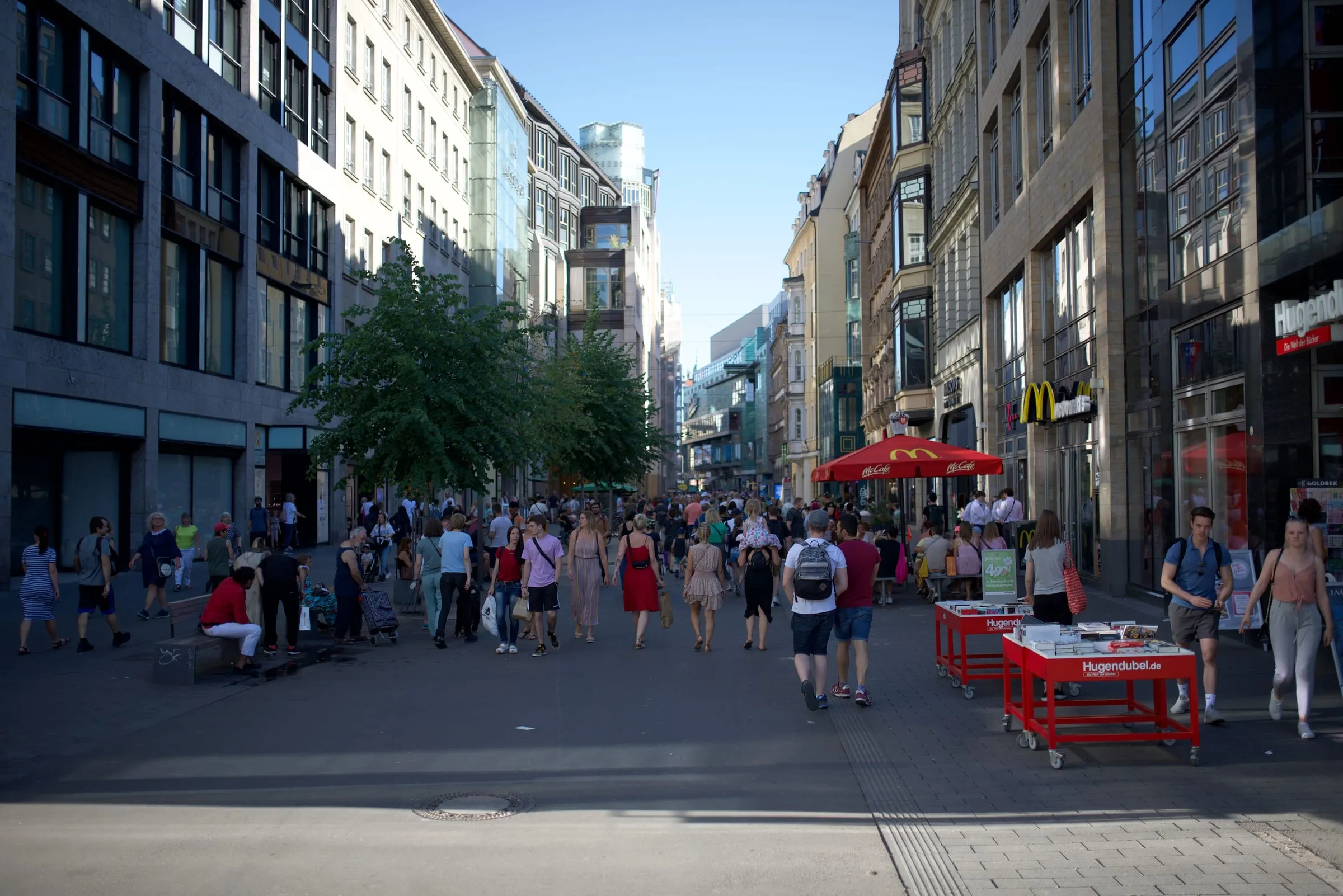
Income needed for a Germany residence permit
With any option
| National D visa fee €37.50 for children under 18. | €75 |
| Residence card in Germany The fee for the first card is paid at the foreigners' authority, and a renewal costs €93. The card takes 4-6 weeks to produce after you apply, and until then the authority issues a certificate called a Fiktionsbescheinigung. | €100 |
The 2026 thresholds come from the Make it in Germany table, the German government portal, and from the German Embassy's Blue Card fact sheet. The visa fee is listed on the embassy page. Residence card fees are set by §45 of the Residence Ordinance.
German residence documents
National D visa
It is placed in your passport at the embassy. You enter Germany with it and, until you get the card, travel in the Schengen area for up to 90 days in any 180-day period. After arrival you register your address and apply for the card at the foreigners' authority.
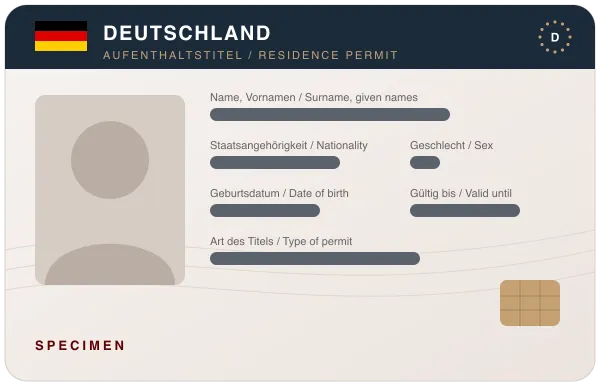
eAT residence card
A plastic card with a chip, photo and fingerprints. It is issued by the foreigners' authority (Ausländerbehörde) where you live. The card shows the ground for the permit and the right to work. The Blue Card and the Opportunity Card are issued in the same format.
Germany residence permit for family members
Spouse or registered partner
Both partners are 18 or older. The spouse passes a German test at A1 before moving, except spouses of Blue Card holders, of self-employed permit holders and of some other permit holders. The family of a Blue Card holder can apply together with them. The spouse gets a permit with the right to work.
Children
Unmarried minor children. A child aged 16 or over who does not move together with the parents needs German or good prospects of integrating in Germany. This condition does not apply to children of Blue Card holders.
Parents
Your parents or your spouse's parents may be admitted if you first received a Blue Card, a skilled worker permit or a self-employed permit on or after 1 March 2024. The authority decides, and your income must cover their living costs. Other relatives are admitted only in exceptional cases.
How to get a residence permit in Germany
Choosing the ground
1-3 daysWe look at your degree, income, job and family and choose the ground on which your documents will pass review. It sets the income threshold, the right to work and the time to permanent residence.
Degree, account and insurance
2-6 weeksWe check your degree in the anabin database and order a ZAB assessment if needed. We open a blocked account if your route requires one and arrange health insurance with an EU insurer.
Documents
2-4 weeksCertificates are apostilled and translated into German. The list depends on the ground.
D visa at the embassy
from a few weeks to 3 monthsYou apply at the German embassy in your country of citizenship or where you live lawfully. For business, financially independent and some family cases the embassy waits for approval from the authority in Germany, so they take longer.
Arrival and residence card
1-3 monthsYou enter Germany on the D visa, register your address within two weeks and apply for a residence card at the foreigners' authority.
Renewal, permanent residence and citizenship
from 21 months to 5 yearsWe renew the permit while the ground remains. Once you have the required time, we apply for permanent residence, and after 5 years in Germany for citizenship.
Germany residence permit requirements
Applicant requirements
- A ground for the permit, such as an employment contract, a business plan, university admission or marriage
- Income or funds at or above the threshold of the chosen ground
- Funds in an account in Germany if the ground requires savings
- A degree recognised in Germany, for the Blue Card and the Opportunity Card
- Health insurance from an EU insurer
- No Schengen entry ban and no grounds for expulsion
- German for permanent residence and citizenship, usually at B1
Documents
- Passport with three blank pages
- National visa application form completed in German in the VIDEX system, and two biometric photos 45 × 35 mm
- Your national ID or internal passport, if your country issues one, with copies of pages bearing stamps
- Document for the ground, such as an employment contract, a commercial register extract or an admission letter
- Proof of funds, such as a blocked account or a formal obligation letter
- Degree with transcript and proof of its recognition
- Health insurance from an EU insurer
- CV with no gaps in years, in German or with a translation
- Marriage and children's birth certificates, apostilled and translated into German, if your family is moving
Germany residence permit FAQ
How do I get a residence permit in Germany?
First you choose the ground: the EU Blue Card, the Opportunity Card, your own business or freelancing, living on your own means, study or family reunion. Then you apply for a national D visa at a German embassy. After arrival you register your address and get a residence card from the foreigners' authority. The process usually takes 3-6 months.
How long does a German residence permit take?
The national D visa takes from a few weeks to a few months. Work and study are faster. Business, family and financially independent cases take longer because the embassy waits for approval from the authority in Germany. After you apply at the foreigners' authority, the card takes 4-6 weeks to produce. If you applied while your visa was still valid, you get a Fiktionsbescheinigung certificate until the card is issued.
Who can apply for a German residence permit?
Germany issues residence permits to citizens of all countries on the same grounds. Citizens of Russia can apply on the same terms, but since 1 January 2026 they need a biometric passport to enter Germany, get a new visa or extend a permit. Funds in Russian bank accounts are not accepted as proof of means.
Who can get a Germany Blue Card?
A Germany Blue Card is issued to a professional with a university degree recognised in Germany and a contract with a German employer for at least 6 months. In 2026 the salary must be at least €50,700 a year, or €45,934.20 for doctors, engineers, IT specialists and graduates of the last 3 years. The card is issued for up to 4 years, and permanent residence is possible after 21-27 months.
How do I get permanent residence in Germany?
Under the general rules, permanent residence in Germany requires 5 years with a residence permit, 60 months of pension contributions and German at B1. A Blue Card holder needs 27 months of work with German at A1, or 21 months with B1. An entrepreneur with a successful business qualifies after 3 years. You also need income without benefits and housing for the whole family.
Can I get a German residence permit by buying property?
No. Germany has no residence permit for buying property and no golden visa. Owned or rented housing is needed only as an address for registration. Residence permits are granted on other grounds: work on the Blue Card, your own business, living on your own means, study or family reunion.
How many years until I can get German citizenship?
German citizenship is granted after 5 years of lawful residence in the country. This rule has applied since 27 June 2024; the period used to be 8 years. The fast-track route after 3 years for especially well-integrated applicants was abolished on 30 October 2025. You need German at B1, income without benefits and a pass in the Life in Germany test.
Does Germany allow dual citizenship?
Yes. Since 27 June 2024, Germany has not required you to give up your previous citizenship when you get a German passport. You can keep your first passport if your own country's law allows it: some countries permit a second citizenship, others withdraw their own when you acquire another. Check this before you apply for naturalisation.
Can financially independent people get a residence permit in Germany?
Yes. This permit is issued under § 7 of the Residence Act, for a purpose the law does not describe separately. The law sets no income threshold: the foreigners' authority decides whether your income from capital, rent or a pension is enough to live in Germany and pay for insurance. You cannot work with this permit, and permanent residence is possible after 5 years.
How do I get a German residence permit for my family?
A spouse and minor children get a German family reunion permit for the term of the permit held by the person they join. A spouse usually needs German at A1, but no language is required for the family of a Blue Card holder or a self-employed permit holder. A spouse with a family permit can work. The family of a Blue Card holder applies together with them.
Can I work with a German residence permit?
Yes, on almost every ground. With a Blue Card you work for the employer named in your contract, with a business permit in your own business, and with a family permit without restrictions. With an Opportunity Card you can work up to 20 hours a week, and a student can work 140 full days or 280 half days a year. You cannot work with a permit for financially independent persons.
What documents do I need for a German residence permit?
For a German D visa you need a passport, the VIDEX form in German, biometric photos, the document for your ground, proof of funds, health insurance from an EU insurer and a CV. For the Blue Card and the Opportunity Card you add your degree with proof of recognition. Certificates are apostilled and translated into German.
Can I apply for a German visa outside my home country?
Yes, if you live lawfully in another country. German embassies accept national visa applications from people who are permanently resident in their district, usually on a residence permit of that country. Foreign nationals are asked to prove that they live there. So you apply where you live.
How long can I stay outside Germany with a residence permit?
A German residence permit lapses if you leave and do not return within 6 months, unless the foreigners' authority has set a longer period. For the Blue Card and its family permits the period is 12 months. Time spent anywhere outside Germany counts, including trips to other EU countries. If you leave for good, the permit lapses at once.
How do I prove income for a German residence permit?
It depends on the ground. For the Blue Card, the employment contract with the annual salary is the proof. For the Opportunity Card and study, you show a blocked account in Germany or a formal obligation letter. Financially independent applicants bring statements of income from capital, rent or a pension. For family reunion you need the payslips and employment contract of the family member who lives in Germany.
What does a German residence permit look like?
A German residence permit is a plastic card the size of a bank card, called an eAT. It shows your photo, name, address, type of permit and its section of the law, the expiry date and a field for notes, such as the right to work. The chip stores your photo and two fingerprints. The Blue Card and the Opportunity Card are issued in the same format.
What if my German visa is refused?
Since 1 July 2025, German embassies no longer review a refusal on a complaint, known as a remonstration. Two options remain: submit a new application that removes the reason for refusal, or file a claim in German at the Berlin Administrative Court. The deadline for the claim is stated in the refusal decision. We review the refusal and choose the faster option for your case.
Does Germany have a digital nomad visa?
No, Germany has no separate visa for digital nomads. You can work remotely for yourself on a freelancer permit if your work counts as a liberal profession and you have clients. Remote employment with a foreign company does not qualify for this permit. For that, we will suggest the Spain digital nomad visa.
What is a § 24 residence permit in Germany?
It is temporary protection under § 24 of the Residence Act for people who fled the war in Ukraine. It is granted by decision of the Council of the EU and is a separate status: it is issued in Germany without a D visa, and you must live in the state the authority assigns you to. You can work with it. It is not one of the six routes on this page.