Portugal residence permit
Six grounds for a residence permit, each with its own income threshold and family rules. We choose the one that fits your income, work and citizenship plans.
- Routes
- 6 programmes
- First permit
- for 2 years
- Permanent residence
- after 5 years

A Portugal residence permit is issued on a specific ground, and each ground has its own income threshold. The most common choices are the D7 visa for people living on a pension, rent or dividends, and the digital nomad visa for remote work for a company abroad. There is also the golden visa for investments from €500,000, the D2 entrepreneur visa, the startup visa for founders of innovative projects and the D3 visa for highly qualified professionals.
Income thresholds are tied to the Portuguese minimum wage, which is €920 a month in 2026. The first residence permit is issued for 2 years and then renewed for 3 years. Permanent residence is available after 5 years. Since 19 May 2026, citizenship is granted after 10 years of residence in the country instead of the previous 5.
Updated:
A new citizenship law came into force. Naturalisation is now possible after 10 years of residence, or 7 years for citizens of EU and Portuguese-speaking countries, and the period counts from the first residence permit. Source
The AIMA migration agency raised its fees for residence permits and renewals, with some fees up by as much as 33%. Source
The minimum wage rose to €920 a month. The D7 visa threshold is now €920 and the digital nomad visa threshold €3,680. Source
Law 61/2025 came into force. Family reunification became possible after two years of residence, except for minor children and for golden visa, D3 visa and EU Blue Card holders. Source
The golden visa for buying property was abolished. Investments in housing and real estate funds no longer give the right to a residence permit. Source
Ways to get a Portugal residence permit

Passive income D7
People living on a pension, rent or dividends
- Income or investment
- from €920 a month in passive income
Digital nomad
Remote employees and freelancers
- Income or investment
- from €3,680 a month
Golden visa
Investors who do not plan to relocate
- Income or investment
- from €500,000 in a fund or company, from €250,000 in culture

Entrepreneurs D2
People starting or buying a business
- Income or investment
- A business plan and savings from €11,040

Startup visa
Founders of technology projects
- Income or investment
- An incubator agreement and savings from €11,040

Highly qualified professionals D3
Professionals with a degree and a job offer
- Income or investment
- A salary from €1,612 a month under contract
| Passive income D7 | Digital nomad | Golden visa | Entrepreneurs D2 | Startup visa | Highly qualified professionals D3 | |
|---|---|---|---|---|---|---|
| Who it suits | People living on a pension, rent or dividends | Remote employees and freelancers | Investors who do not plan to relocate | People starting or buying a business | Founders of technology projects | Professionals with a degree and a job offer |
| Income or investment | from €920 a month in passive income | from €3,680 a month | from €500,000 in a fund or company, from €250,000 in culture | A business plan and savings from €11,040 | An incubator agreement and savings from €11,040 | A salary from €1,612 a month under contract |
| Work in Portugal | Allowed | For companies and clients abroad | Allowed | In your own company or as a sole trader | In your own startup | For the employer named in the contract |
| First permit | 2 years, then 3 years | 2 years, then 3 years | 2 years, then 2 years at a time | 2 years, then 3 years | 2 years, then 3 years | 2 years, then 3 years |
| Where to apply | At a consulate only | At a consulate only | Online with AIMA, no visa needed | At a consulate only | Application to IAPMEI, then the consulate | At a consulate or in Portugal |
| Processing time | Visa within 60 days, then the permit in 2-4 months | Visa within 60 days, then the permit in 2-4 months | Usually 12-18 months | Visa within 60 days, then the permit in 2-4 months | IAPMEI within 30 working days, visa within 60 days, permit in 2-4 months | Visa within 60 days, then the permit in 2-3 months |
| Days in the country | No absences longer than 6 consecutive months | No absences longer than 6 consecutive months | 7 days in the first year, then 14 days every two years | No absences longer than 6 consecutive months | No absences longer than 6 consecutive months | No absences longer than 6 consecutive months |
| Permanent residence and citizenship | Permanent residence after 5 years, citizenship after 10 | Permanent residence after 5 years, citizenship after 10 | Permanent residence after 5 years, citizenship after 10 | Permanent residence after 5 years, citizenship after 10 | Permanent residence after 5 years, citizenship after 10 | Permanent residence after 5 years, citizenship after 10 |
What a Portugal residence permit gives you
Living in Portugal with your family
You live in the country for the whole term of the permit. Your spouse and children apply with you or later, through family reunification.
Travel in the Schengen area
With a Portuguese residence card you travel to other Schengen countries without a visa, for up to 90 days in any 180.
Permanent residence after 5 years
After five years on a temporary permit you can apply for permanent residence. It requires a Portuguese language exam at A2 level.
Work on almost every route
With a permit based on the D7, D2 or D3 visa or the golden visa you can work as an employee or for yourself. A digital nomad works for companies and clients abroad.
Schools and healthcare
Residents' children attend state schools. Once you register at your local health centre, you receive a national health service user number.
A path to citizenship
Since 19 May 2026, Portuguese citizenship is granted after 10 years of legal residence. The period counts from the date the first residence permit was issued.

Income needed for a Portugal residence permit
Thresholds are based on the 2026 minimum wage of €920 a month. The conditions for each route come from the websites of Portuguese consulates and the AIMA migration agency. The consular fee for a national visa is €90; we will give you the AIMA residence permit fees at the consultation.
Portugal resident documents
National D visa
It is placed in your passport at the consulate. The visa is valid for 4 months and allows two entries. During that time you travel to Portugal and give your biometrics at AIMA.
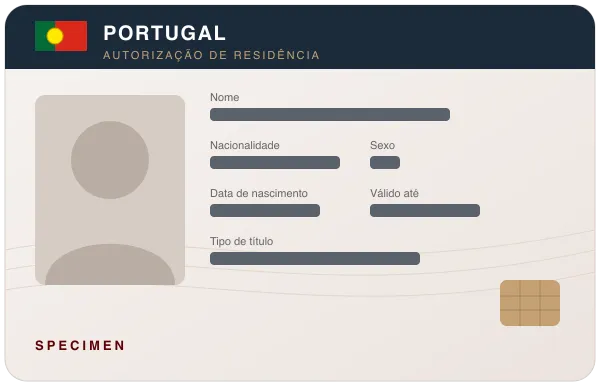
Residence card
A plastic photo card issued by the AIMA migration agency. The first card is issued for 2 years and the next one for 3 years. It lets you travel in the Schengen area and proves your status in Portugal.
Who can be included
Spouse or partner
Marriage or a registered partnership. If your spouse applies with you, €460 a month is added to the income threshold. If they join you later, since October 2025 reunification is possible after two years of your residence, or after 15 months if you lived together for at least 18 months before the move. Golden visa and D3 visa holders do not have to wait.
Children
Children under 18 join without the two-year wait. Adult children are included if they are unmarried and dependent on you: up to 21 on the D7 and digital nomad visas, and up to 25 on the golden visa if they are studying. €276 a month is added to the income threshold for each child.
Parents
Your parents or your spouse's parents, if they are dependent on you. They can be included in a D7 or digital nomad application, with €460 a month added to the income for each parent, and in a golden visa application.

How to get a Portugal residence permit
Choosing the route
1-3 daysWe look at your income, work and family and choose the route on which your documents will pass review. It determines the income threshold, the waiting period for your family and where you apply.
Tax number, bank account and housing
3-6 weeksWe obtain a Portuguese NIF tax number, open an account with a Portuguese bank and transfer your savings to it. We arrange a 12-month lease, since the consulate will not issue the visa without one.
Documents
2-4 weeksThe police clearance certificate and the marriage and birth certificates are apostilled and translated into Portuguese. The list depends on the route and the consulate.
Visa at the consulate
up to 60 daysYou apply at the Portuguese consulate in your country of citizenship or in the country where you live legally. The golden visa is filed online with AIMA, without the consulate.
Biometrics and residence card
2-4 monthsYou enter Portugal on the D visa and give your biometrics at AIMA within 4 months. The residence card is sent by post after the decision.
Renewal and permanent residence
after 2 years and after 5 yearsThe first permit is renewed for 3 years if the grounds still apply. After 5 years we apply for permanent residence, which requires Portuguese at A2 level.
Portugal residence permit requirements
Applicant requirements
- The applicant is at least 18 and not an EU citizen
- No criminal record in the country of citizenship or the country of residence over the last year
- Income or savings at or above the threshold of the chosen route
- Savings in a Portuguese bank account
- Housing in Portugal, usually a 12-month lease
- Health insurance valid in Portugal
- No Schengen entry ban
Documents
- Passport valid for at least 3 months after the visa expires
- National visa application form and photo
- Police clearance certificate, apostilled and translated into Portuguese
- Proof of income and a Portuguese bank statement
- NIF tax number
- Lease agreement or title deed
- Health insurance
- Marriage certificate and children's birth certificates, apostilled, if your family is coming
Portugal residence permit FAQ
How do I get a Portugal residence permit?
First you choose the route: D7 passive income, remote work, the golden visa, your own business or a job offer. Then you get a tax number, open a bank account, rent housing and apply for a national visa at a Portuguese consulate. In Portugal you give your biometrics at AIMA and receive a residence permit for 2 years. The whole process takes 4-6 months.
Who can apply for a Portugal residence permit?
Non-EU citizens aged 18 and over who meet the conditions of one of the routes. Citizens of Russia can apply on the same terms as other applicants; for them we check golden visa eligibility separately before any investment. The national visa application is filed at a Portuguese consulate in your country of citizenship or in the country where you live legally. The police clearance certificate and civil records are apostilled and translated into Portuguese.
What does a Portugal residence permit give you?
A Portugal residence permit gives you the right to live in the country, to work on almost every route, to travel in the Schengen area for up to 90 days in any 180 and to bring your family. Children attend state schools. After 5 years you can obtain permanent residence, and after 10 years you can apply for Portuguese citizenship.
How many years until I can get Portuguese citizenship?
Since 19 May 2026, Portuguese citizenship is granted after 10 years of legal residence, or 7 years for citizens of EU and Portuguese-speaking countries. The period counts from the date the first residence permit was issued. You need to pass a Portuguese language test at A2 level. Applications filed before 19 May 2026 are assessed under the old 5-year rule.
How can I move to Portugal?
To move to Portugal you need a residence permit on one of the routes: passive income from €920 a month, remote work with income from €3,680, your own business, an employment contract or an investment from €500,000. First you obtain a national visa at the consulate, then in Portugal you give your biometrics and receive a residence permit for 2 years.
Can I get a Portugal residence permit by buying property?
No. Since 7 October 2023, buying a home no longer gives the right to a Portugal golden visa. The investment residence permit is now granted for a contribution of €500,000 or more to a fund or to the capital of a Portuguese company, or €250,000 or more to cultural projects. Owned or rented housing is needed as your address for the D7 visa and other routes.
How do I get permanent residence in Portugal?
Permanent residence in Portugal is granted after 5 years of legal residence on a temporary permit. You need means of subsistence, housing and Portuguese at A2 level. Golden visa holders do not need to live in the country full time for permanent residence; meeting the minimum stay rule is enough.
Can a freelancer or self-employed person get a Portugal residence permit?
Yes. A freelancer with clients abroad gets a Portugal residence permit on the digital nomad visa if they earn €3,680 a month or more and prove it with contracts and statements for 3 months. If you want to work as a self-employed person for clients in Portugal, the D2 visa fits: you register with the tax office as a sole trader and present a business plan.
How much money do I need for a Portugal residence permit?
A Portugal residence permit on the D7 visa requires passive income from €920 a month and savings from €11,040 in a Portuguese bank account. A digital nomad needs income from €3,680 a month, and a professional on the D3 visa a salary from €1,612 a month. The golden visa requires an investment from €500,000.
Can I work with a Portugal residence permit?
Yes, on almost every route. With a permit based on the D7 visa, the D2 entrepreneur visa, the D3 professional visa or the golden visa you can work in Portugal as an employee or for yourself. A digital nomad works for companies and clients outside Portugal.
Can I bring my family on a Portugal residence permit?
Yes. It is best to apply for your spouse and children at the same time as yourself: €460 a month is then added to the income threshold for a spouse and €276 for each child. If your family comes later, since October 2025 a spouse without shared minor children can join you after two years of your residence. This rule does not apply to golden visa and D3 visa holders.
What do I need for a Portugal residence permit?
For a Portugal residence permit you need a passport, a NIF tax number, a Portuguese bank account with savings, a 12-month lease, an apostilled police clearance certificate and health insurance. On top of these come the documents for your route: proof of passive income, a contract with a foreign company, a business plan or an employment contract.