Spain residence permit
Six grounds for a residence permit, each with its own income threshold and right to work. We choose the one that fits your income, work and family.
- Routes
- 6 programmes
- First permit
- up to 3 years
- Permanent residence
- after 5 years

Spain has no single residence permit for every case. The law sets out several grounds, and each has its own income threshold, term and right to work. The most popular are the digital nomad visa, if you work remotely for a company abroad, and the non-lucrative residence permit, which does not allow you to work. Other routes cover startups, study, a job offer from a Spanish employer and family reunification.
Spain abolished its residence permit for investment on 3 April 2025, and buying property no longer gives a right to residence. Income thresholds are based on two official indicators: IPREM, which is €600 a month in 2026, and the minimum wage, €1,221 a month paid 14 times a year.
Updated:
The 2026 minimum wage rose to €1,221 a month paid 14 times a year. The digital nomad income threshold is now €2,849 a month. Source
The new Immigration Regulation came into force. Non-lucrative residents must live in Spain more than 183 days a year to renew, and students can work up to 30 hours a week. Source
Spain stopped issuing residence permits for investment, including for property purchases from €500,000. Applications filed before this date are reviewed under the old rules. Source
The Startup Law 28/2022 came into force. It introduced a residence permit for digital nomads and changed the conditions for startup founders. Source
Ways to get a Spain residence permit

Digital nomad
Remote employees and freelancers
- Income or funds
- from €2,849 a month

Non-lucrative
People living on a pension, rental income or dividends
- Income or funds
- from €2,400 a month

Startup
Founders of an innovative project
- Income or funds
- from €2,849 a month, project approved by ENISA

Study
University, college and course students
- Income or funds
- from €600 a month

Highly qualified professionals
Professionals with a job offer from a Spanish company
- Income or funds
- from €41,356 a year under the employment contract

Family reunification
Spouse and children of a resident who has lived in Spain for a year
- Income or funds
- from €900 a month for two
| Digital nomad | Non-lucrative | Startup | Study | Highly qualified professionals | Family reunification | |
|---|---|---|---|---|---|---|
| Who it suits | Remote employees and freelancers | People living on a pension, rental income or dividends | Founders of an innovative project | University, college and course students | Professionals with a job offer from a Spanish company | Spouse and children of a resident who has lived in Spain for a year |
| Income or funds | from €2,849 a month | from €2,400 a month | from €2,849 a month, project approved by ENISA | from €600 a month | from €41,356 a year under the employment contract | from €900 a month for two |
| Work in Spain | For companies abroad, up to 20% for Spanish ones | Not allowed | In your own project | Up to 30 hours a week | For the employer who hired you | Spouse and children work without a separate permit |
| First permit | 3 years, or a 1-year visa through a consulate | 1 year, then 2 years | 3 years, then 2 years | For the length of the course | up to 3 years, then 2 years | For the term of the relative's permit, at least 1 year |
| Where to apply | At a consulate or in Spain | At a consulate only | At a consulate or in Spain; citizens of Russia apply in Spain only | At a consulate; university students can apply in Spain | You or your employer apply to the UGE | You apply in Spain, your relative gets a visa at a consulate |
| Processing time | 20 days when applying in Spain | 1-3 months | 20 days by law, about 2 months in practice | 1-3 months | 20 days for a decision | up to 2 months for a decision |
| Tax residence | After 183 days, 24% rate for employees | Renewal requires 183 days a year in Spain | After 183 days, a 24% rate is available | General 183-day rule | After 183 days, a 24% rate is available | General 183-day rule |
| Permanent residence and citizenship | Permanent residence after 5 years, citizenship after 10 | Permanent residence after 5 years, citizenship after 10 | Permanent residence after 5 years, citizenship after 10 | Years of study count as half towards the 5 years | Permanent residence after 5 years, citizenship after 10 | Permanent residence after 5 years, citizenship after 10 |
What a Spain residence permit gives you
Living in Spain with your family
You live in the country for the full term of the permit. Your spouse and children, and on some routes your parents, receive residence permits with you.
Travel in the Schengen area
With a Spanish residence card you travel to other Schengen countries without a visa, for up to 90 days in any 180-day period.
Permanent residence after 5 years
After five years of legal residence you can obtain long-term residence. The card is renewed every five years.
The right to work depends on the route
A digital nomad works for companies abroad, a professional with a job offer works in Spain, and a student can work up to 30 hours a week. Non-lucrative residents may not work.
Schools and healthcare
Residents' children attend state schools. State healthcare is available to those who pay Spanish social security contributions.
A path to citizenship
As a general rule, citizenship is granted after 10 years of residence and exams in Spanish and on the country's constitution and society.

Income requirements for a Spain residence permit
Thresholds are based on the 2026 minimum wage and on IPREM; the percentages are set in the Immigration Regulation. The visa fee is paid at the Spanish consulate where you apply, in local currency at the consulate's exchange rate.
Spanish residence documents
National visa D
It is placed in your passport if you apply through a consulate. You enter Spain on it and apply for a residence card within a month.
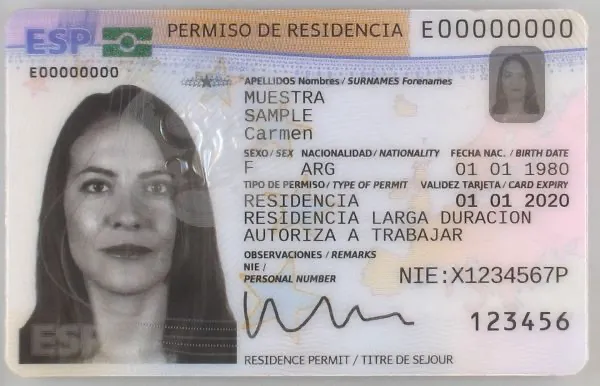
TIE residence card
A plastic card with your photo and NIE number. The police issue it after you give your fingerprints. With it you travel in the Schengen area and prove your status in Spain.
Who can be included
Spouse or partner
Marriage, a registered partnership or a cohabiting relationship you can prove. On most routes, a set amount is added to the applicant's income threshold for each family member.
Children
Minors, and adult children who cannot support themselves, for example for health reasons.
Parents
If they are over 65 and dependent on you. Under family reunification they can join you after 5 years in Spain. A digital nomad, a startup founder and a highly qualified professional can include them in the application from the start.

How to get a residence permit in Spain
Choosing the route
We look at your income, work and family and choose the route under which your documents will pass review. The route sets the income threshold, the right to work and the term of the permit.
Documents
2-6 weeksThe police certificate is apostilled, and a sworn translator translates all documents. The list depends on the route and the consulate.
Visa at a consulate or application in Spain
20 days to 3 monthsNon-lucrative applicants apply only through a consulate. Digital nomads, startup founders and professionals can apply from Spain if they are there legally.
Entry and residence card
1-2 monthsIf you applied through a consulate, you enter on a D visa and within a month book a police appointment for fingerprints. The TIE card is issued a few weeks later.
Renewal
2 months before expiryThe application is filed in the last 60 days of the permit. You must keep meeting the conditions of the route. Non-lucrative residents must also spend 183 days a year in Spain.
Permanent residence
after 5 yearsAfter five years of legal residence we apply for long-term residence. Absences during that time must not exceed six months in a row or ten months in total.
Spain residence permit requirements
Applicant requirements
- The applicant is 18 or older and not an EU citizen
- No criminal record in the country of citizenship or in countries of residence in recent years
- Income or savings at or above the threshold for the chosen route
- Health insurance from a company authorised in Spain, with cover equal to the state healthcare system
- No ban on entering the Schengen area
Documents
- Passport valid for at least one year, with two blank pages
- National visa application form or residence permit application
- Police certificate with an apostille and translation
- Proof of income or savings
- Health insurance
- Medical certificate, for non-lucrative applicants
- Marriage and children's birth certificates, if your family is coming
- Receipt for the fee
Spain residence permit FAQ
How do I get a residence permit in Spain?
First choose the route: remote work, passive income, a startup, study, a job with a Spanish company or family. Then file the documents at a Spanish consulate or, for some routes, in Spain itself. After approval you give fingerprints at the police and receive a TIE residence card. The first permit is issued for 1-3 years.
Can you still get a Spain residence permit?
Yes. In 2026 Spain issues residence permits to digital nomads, non-lucrative residents, startup founders, students, highly qualified professionals and relatives of residents. Only the golden visa has closed: since 3 April 2025 no residence permits are granted for property purchases or other investments, and new applications are not accepted.
How much money do you need in the bank for a Spain residence permit?
For a non-lucrative residence permit in Spain you need €2,400 a month for the applicant, or €28,800 for the first year, plus €600 a month for each family member. A digital nomad needs an income from €2,849 a month, and a student from €600 a month. Thresholds are recalculated when IPREM and the minimum wage change.
Can I apply from my home country?
Yes. Spanish consulates accept national visa applications, including for the digital nomad visa and the non-lucrative visa. Your police certificate is apostilled and translated into Spanish. If you are legally in Spain, some routes let you file there. Citizens of Russia apply on the same terms as other applicants.
Who can get a residence permit in Spain?
Spain grants a residence permit to people who meet one of the grounds in the law: remote work for a foreign company, passive income, an innovative startup, study, a job offer from a Spanish employer or joining a relative who is a resident. Each route has its own income threshold and document list.
What does a Spain residence permit give you?
A Spain residence permit gives you the right to live in the country, travel in the Schengen area for up to 90 days in any 180-day period and bring your family. The right to work depends on the route. After 5 years of legal residence you can obtain permanent residence, and after 10 years apply for citizenship by passing the language and civics exams.
Can I get a Spain residence permit by buying property?
No. Spain abolished the residence permit for investment by Organic Law 1/2025, and the programme closed on 3 April 2025. Previously the permit was granted for buying property from €500,000. Now owned or rented housing serves only as your address on other routes, such as the digital nomad visa or the non-lucrative residence permit.
Can you work with a Spain residence permit?
It depends on the route. A digital nomad in Spain works for companies abroad, and a freelancer can take Spanish clients if they make up no more than 20% of the work. A professional works for the employer who hired them, and a student up to 30 hours a week. A non-lucrative residence permit does not allow work.
How do I get permanent residence in Spain?
Permanent residence, or long-term residence, in Spain is granted after 5 years of legal residence on a temporary permit. Absences during that time must not exceed 6 months in a row or 10 months in total. Years of study count as half. The long-term residence card is renewed every 5 years.
What are the requirements for a Spain residence permit?
For a Spain residence permit you need a passport valid for at least one year, an apostilled police certificate, health insurance from a company authorised in Spain, and proof of income or savings at or above the threshold for your route. Add the route's own documents: a contract with a foreign company, a business plan, university enrolment or an employment contract.